Ancient greece technology gave us, around 100 BC, a hand-cranked bronze computer accurate enough to predict solar eclipses decades ahead. That single object, the Antikythera mechanism, sat on the seafloor for two millennia before anyone believed it was real. We’re still arguing about how they built it. That’s worth holding onto, because it reframes the whole conversation: the Greeks weren’t primitive inventors stumbling toward modernity, they were running a parallel track that in some areas outpaced anything Europe managed for the next 1,400 years.
The core period runs roughly 800 to 300 BC, though some of the most dramatic engineering came just after, during the Hellenistic era when Greek thinking spread east and west. The popular image is philosophers in togas doing geometry. The reality includes water-powered mills, compound pulleys lifting warships, and incendiary weapons that burned on water. Comparing what the Greeks actually produced against what most people assume they produced is where things get interesting.
Below I’ve tried to weigh the most important areas against each other rather than just list them. Some fields the Greeks dominated; others they started but left for Rome to finish. That distinction matters if you want to understand which parts of modern technology trace back to Athens or Alexandria rather than to later civilisations borrowing Greek notes.
Key Innovations of Ancient Greece
The Antikythera mechanism deserves more than a footnote. Recovered from a shipwreck off the Greek island of Antikythera in 1901, it contains at least 30 interlocking bronze gears and could model the positions of the sun and moon, predict eclipses, and track the four-year Olympic cycle. Nothing mechanically comparable appears in the historical record for roughly 1,000 years after it was made. Modern CT scanning in the 2000s finally revealed the full gear train, and researchers at University College London published a working reconstruction as recently as 2021.
Archimedes sits in a separate category almost by himself. His screw pump, still manufactured and sold today for moving grain and wastewater, was designed around 250 BC. His compound pulley system let a single person haul loads that would otherwise need a team. He also reportedly designed war machines for the defence of Syracuse, including a crane-like claw that could grab Roman ships and capsize them. Whether every detail of that story holds up is debatable, but the underlying mechanics are sound.
Greek fire is trickier to pin down. The incendiary weapon used by the Byzantine Empire is often credited to Greek knowledge, but the formula appears later, around the 7th century AD, and the exact composition is still unknown. The Greeks did use fire ships and incendiary projectiles earlier, so the lineage is plausible, just not as direct as often claimed. Worth being honest about that gap.
Engineering Marvels in Architecture
Greek theatres are a case study in applied acoustics. The theatre at Epidaurus seats around 14,000 people and delivers speech clearly to the back rows without amplification. Modern acoustic engineers have measured the effect and traced it partly to the limestone seating, which filters low-frequency background noise while letting higher-frequency speech pass through. The Greeks almost certainly arrived at this through trial and refinement rather than formal acoustic theory, but the result is indistinguishable from deliberate engineering.
Aqueducts are usually credited to Rome, but Greeks were building them centuries earlier. The Eupalinos tunnel on Samos, completed around 530 BC, is a 1,036-metre passage dug from both ends and meeting in the middle with an error of less than a metre. That required surveying techniques sophisticated enough that modern civil engineers still study the project. Rome scaled these ideas up dramatically, but the foundational knowledge came from Greek engineers.
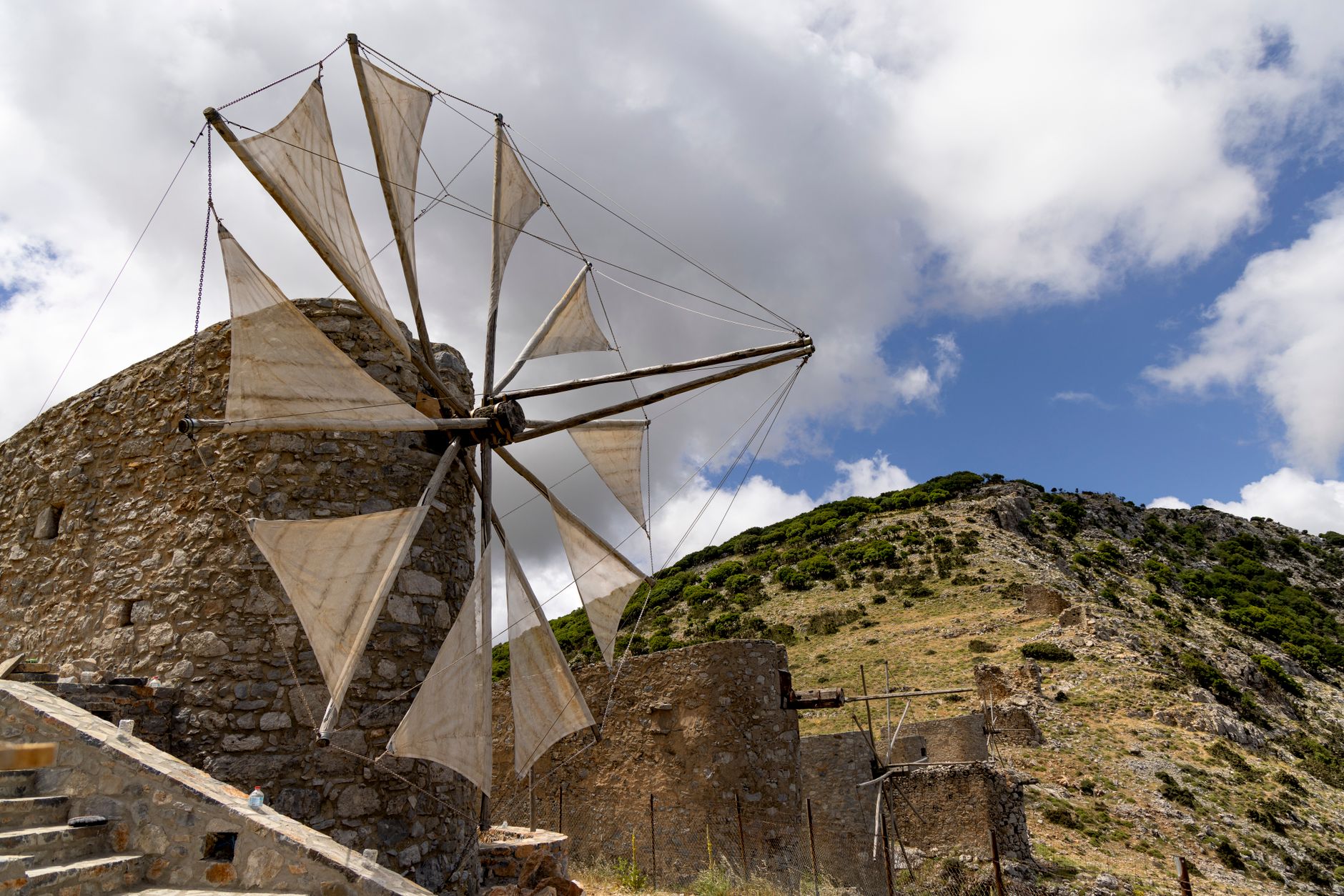
Water mills are another area where Greek priority often gets overlooked. Evidence from the 3rd century BC shows Greek-designed horizontal water mills in use across the Mediterranean. Rome later adopted and spread them. The pattern repeats across several fields: Greece invents, Rome industrialises.
The Role of Mathematics and Science
The Pythagorean theorem is probably the most widely taught piece of ancient greece technology’s mathematical output, though the relationship between the sides of a right triangle was known in Babylon and Egypt earlier. What Pythagoras and his followers contributed was a formal proof and a framework for deductive reasoning that could be applied generally. That shift, from knowing a rule to proving why it holds, is arguably more important than any specific theorem.
Euclid’s Elements, compiled around 300 BC, remained the standard geometry textbook in Western education into the 20th century. Archimedes came close to calculus, calculating areas and volumes using a method of exhaustion that anticipates integral calculus by nearly 1,900 years. When Newton and Leibniz formalised calculus in the 17th century, Greek fingerprints were all over the foundation they built on.
Eratosthenes calculated the circumference of the Earth around 240 BC using shadow angles and the distance between two Egyptian cities. His estimate was within about 2% of the actual value. Columbus sailed west in 1492 partly because he trusted a much smaller, less accurate estimate. Greek science, in that specific case, was more reliable than what came 1,700 years later.
Lasting Impact on Future Civilizations
Rome absorbed Greek technical knowledge so thoroughly that separating the two traditions gets genuinely difficult. Roman engineers read Greek texts, hired Greek craftsmen, and in many cases simply copied working designs. The Antikythera mechanism was on a ship heading toward Rome when it sank, which tells you something about the direction of that knowledge flow. Roman concrete and road engineering went beyond anything the Greeks built at scale, but the mathematical and mechanical foundations were largely inherited.
The Islamic Golden Age, running roughly the 8th to 13th centuries, kept Greek scientific texts alive when much of Europe had lost access to them. Scholars in Baghdad translated Archimedes, Euclid, and Aristotle, added their own advances in algebra and optics, and passed the combined knowledge back to Europe during the Renaissance. Without that chain, the Scientific Revolution probably looks quite different and happens considerably later.
Greece’s Legacy in Modern Engineering
Ancient greece technology didn’t influence history in a vague, inspirational way. Specific mechanisms, theorems, and structural principles from the Greek world are still embedded in contemporary engineering practice. The screw pump is in active production. Pythagorean geometry runs underneath every piece of CAD software. The acoustic principles at Epidaurus informed the design of the Sydney Opera House (not a metaphor, an actual documented reference). These are direct technical inheritances, sometimes separated by 2,000 years but still traceable. What the Greeks built between 800 and 300 BC, and through the Hellenistic period that followed, set a baseline that subsequent civilisations spent centuries catching up to.
FAQs
What technology did ancient Greece invent?
Greeks developed the Antikythera mechanism, Archimedes’ screw pump, compound pulleys, horizontal water mills, and sophisticated acoustic theatre design, among other advances, between roughly 800 and 100 BC.
How did Greek mathematics influence modern science?
Euclidean geometry and Archimedes’ proto-calculus methods fed directly into Newton’s work. Without Greek mathematical frameworks, the 17th-century Scientific Revolution would likely have been delayed by generations.
What is the Antikythera mechanism used for?
It tracked celestial positions, predicted solar and lunar eclipses, and followed the Olympic cycle. It’s the oldest known mechanical computer, dated to around 100 BC.